Showing posts with label Mk III Spitfire. Show all posts

Triumph Spitfire Classic Cars - Spitfire Mark III Part 2

Triumph Spitfire Classic Cars - Spitfire Mark III

Triumph Spitfire Classic Cars
Picture Of 1962 Triumph Spitfire Classic Cars

On 8 February 1968, Standard-Triumph General Manager George Turnbull personally drove the 100,000th Triumph Spitfire off the end of the Canley production line. More than 75% of the total production had been exported outside the UK including 45% to the USA and 25% to mainland European markets.
Triumph-Spitfire Classic Cars
Picture Of Triumph Spitfire Classic Cars

Starting in 1969, however, US-bound models had to be changed to comply with new safety/emission regulations. It basically ended an era and you may hear models after 1969 be referred to as "federal" Spitfires. The changes included a slight decrease in horsepower (68 bhp) due to emissions control, the instrument panel was moved in front of the driver, and new seats were introduced which had integrated headrests to help against whiplash.


Triumph Spitfire Classic Cars - Spitfire Mark III Part 1

Triumph Spitfire Classic Cars - Spitfire Mark III

Triumph Spitfire Classic CarsPicture Of Triumph Spitfire Classic Cars

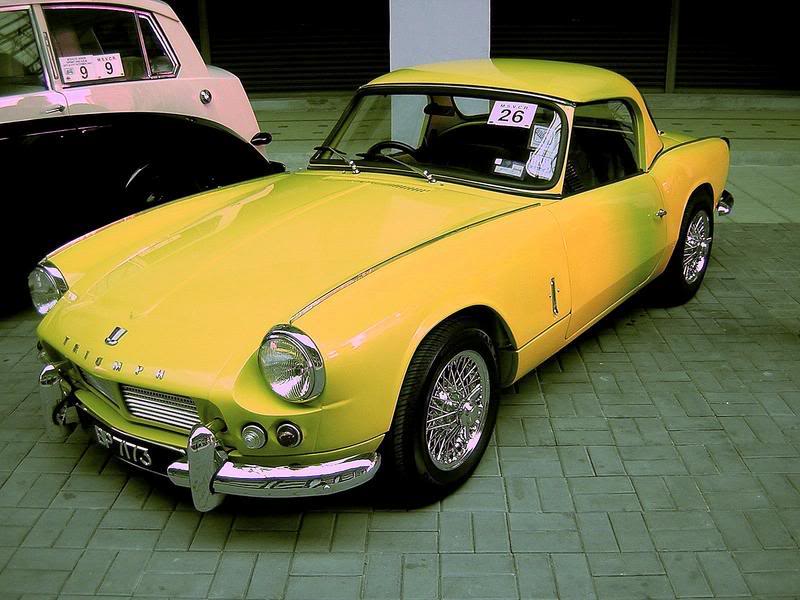
The Mark III, introduced in March 1967, was the first major facelift to the Spitfire. The front bumper was raised in response to new crash regulations, and although much of the bonnet pressing was carried over, the front end looked quite different. The rear lost the overriders from the bumper but gained reversing lights as standard (initially as two separate lights on either side of the number plate, latterly as a single light in a new unit above the number plate) the interior was improved again with a wood-veneer instrument surround. A folding hood replaced the earlier "build it yourself" arrangement. For most of the Mark III range, the instrument cluster was still centre-mounted (as in the Mark I and Mark II) so as to reduce parts bin counts (and thereby production costs) for right-hand and left-hand drive versions.

Triumph-Spitfire Classic CarsPicture Of Triumph Spitfire Classic Cars

The 1147 cc engine was replaced with a bored-out 1296 cc unit, as fitted on the new Triumph Herald 13/60 and Triumph 1300 saloons. In SU twin-carburettor form, the engine put out a claimed 75 bhp (56 kW) and made the Mark III a comparatively quick car by the standards of the day. Popular options continued to include wire wheels, a hard top and a Laycock de Normanville overdrive, and far more relaxed and economical cruising at high speeds. The Mark III was the fastest Spitfire yet, achieving 60 mph (97 km/h) in 12.5 seconds.The Mark III actually continued production into 1971, well after the Mark IV was introduced.


Triumph Spitfire Classic Cars - Model

Picture Of Triumph Spitfire Mark III Classic Cars

Models Five separate Spitfire models were sold during the production run

Model name Engine Year Number built
Triumph Spitfire 4 (Mark I) 1147 cc inline 4 1962–1965 45,763
Triumph Spitfire Mark II 1147 cc inline 4 1965–1967 37,409
Triumph Spitfire Mark III 1296 cc inline 4 1967–1970 65,320
Triumph Spitfire Mark IV 1296 cc inline 4 1970–1974 70,021
Triumph Spitfire 1500 1493 cc inline 4 1974–1980 95,829


A Brief History - Triumph Spitfire Cars Part 2

A Brief History - Triumph Spitfire Cars

Triumph Spitfire CarsPicture Of triumph spitfire 1500 Cars

In 1965 the Mark II model was launched, and its engine now produced 67bhp due to a revised camshaft and four branch exhaust manifold. A diaphragm spring clutch was now also fitted. Exterior modifications on the Mk II included a redesigned front grill and emblems on the rear wings, whilst the interior benefited from improved seats, and carpets replaced the earlier models rubber matting. Further improvements were to come with the Mk III which arrived in 1967, the most obvious being styling changes which included a new design of raised front bumper to comply with USA regulations. The engine had been replaced with a 1296cc unit producing 75bhp, and the brakes updated accordingly to cope with the extra performance by enlargement of the front callipers. The interior of the Mk III was complimented by a wood veneer dashboard and better seats. The folding soft-top was also improved and became permanently attached and no longer had to be stored in the boot when not in use.

< Triumph-Spitfire CarsPicture Of 1972 Triumph Spitfire Mark IV Cars

In 1970 Michelotti was brought in to redesign the Spitfire, bringing the looks more in line with other Triumphs in the range which he had recently restyled – or recently designed - such as the Triumph Stag which was launched in June of the same year. New rear light clusters, flared wheelarches and thinner bumpers with plastic underriders were among the styling changes. The whole of the interior was completely restyled and was this restyled car was then launched as the Mk IV.

Triumph Spitfire-CarsPicture Of 1972 Triumph Spitfire Mark III Cars

The MkIV used the 1296cc engine from the Mk III, although improvements to bearing size and con rods were made. Contrary to popular rumour, the engine was in no way detuned for the Mk IV on its introduction. Yes, the Mk IV was not as fast as the Mk III, but this was due to higher gearing and weight increase more than anything else. Although the Mk IV was quoted as producing only 63 bhp as opposed to 75bhp for the Mk III, it was just that the output was now measured using the German DIN system. However In 1972 the engine was detuned to comply with United States emission regulations. Other mechanical changes to the Mk IV Spitfire were an all synchromesh gearbox and much improved rear suspension. The Mk IV Spitfire was finally replaced with what was to be the last incarnation of the Spitfire - the Spitfire 1500 - in 1974, which continued in production with effectively only minor changes until 1980.


twitter widget top